
Microsoft Power Platform can be a force multiplier for modern organizations looking to accelerate digital transformation. With tools like Power Apps, Power Automate, and Power BI, businesses can rapidly build applications, automate workflows, and generate data insights without traditional development cycles.
One of the most powerful aspects of the platform is that it empowers both professional developers and citizen developers to create solutions that improve operations and productivity. However, as adoption grows, organizations often discover that innovation without structure can quickly create challenges. Hundreds or even thousands of apps, flows, and reports may be created across departments without clear oversight.
To support innovation while maintaining control, organizations need a structured Power Platform governance framework supported by a Power Platform Center of Excellence (CoE).
Why a Power Platform Governance Framework Is Essential
As Power Platform adoption expands across an organization, governance becomes a foundational requirement for sustainable growth.
A well-designed Power Platform governance framework helps organizations maintain control of their environment while still empowering teams to build solutions that solve real business problems.
Without governance, organizations commonly experience:
- Security risks as apps and flows interact with sensitive data without clear access controls.
- Compliance challenges when solutions do not align with regulatory requirements such as HIPAA, GDPR, or internal data governance policies.
- Operational inefficiencies caused by duplicate apps, abandoned workflows, and unclear ownership of solutions.
A governance framework introduces structure to the platform by defining policies, lifecycle management processes, environment strategies, and security controls. This structure allows organizations to scale Power Platform safely while continuing to encourage innovation.
What Is a Power Platform CoE?
A Power Platform Center of Excellence (CoE) is the organizational model used to manage and govern Power Platform adoption across the enterprise. Rather than limiting innovation, a CoE creates a structured support system that helps citizen developers build solutions responsibly and effectively.
A mature Power Platform CoE typically focuses on four core areas.
- Governance establishes policies for environments, data protection, connectors, and solution lifecycle management.
- Enablement provides training, best practices, and guidance to help citizen developers build effective solutions.
- Support offers architecture guidance and escalation paths for more complex development scenarios.
- Visibility provides monitoring and reporting so organizations can understand how Power Platform is being used across the business.
Together, these components help organizations balance innovation with security and compliance.
The Process for Building a Power Platform CoE
Building a successful Power Platform CoE requires more than simply deploying the Microsoft CoE Starter Kit. Organizations must establish a structured approach that aligns governance, technology, and business needs.
The following process is commonly used to establish a scalable Power Platform governance framework.
Assess the Current Power Platform Environment
The first step in building a Power Platform CoE is understanding how the platform is currently being used. This assessment provides visibility into existing apps, flows, and makers across the organization.
Typical assessment activities include:
- Inventorying Power Apps, Power Automate flows, and Power BI reports
- Identifying active citizen developers and development patterns
- Reviewing environments, connectors, and integrations
- Identifying potential security or compliance risks
- Evaluating existing governance policies and controls
For many organizations, this stage reveals significant organic growth that occurred without centralized governance.
Implement the Power Platform CoE Starter Kit
Microsoft provides the Power Platform CoE Starter Kit as a foundation for monitoring and managing Power Platform usage. However, large organizations typically require customization to align the toolkit with their governance model and internal processes.
Implementation often includes deploying the CoE Starter Kit components, configuring governance dashboards, establishing monitoring for apps and flows, and integrating the platform with security and compliance tools. These capabilities provide the visibility and automation necessary to manage the platform effectively.
Establish Cross-Functional Governance Teams
A Power Platform CoE should not operate solely within IT. Successful governance programs involve collaboration across multiple departments. Key stakeholders often include IT administrators, security and compliance teams, data governance leaders, and representatives from business units that heavily use Power Platform. Experienced makers and internal champions may also participate in the CoE to help represent the needs of citizen developers. This collaborative model ensures governance policies are both technically sound and aligned with business requirements.
Enable and Grow the Maker Community
A successful Power Platform CoE does more than enforce governance. It also empowers employees to innovate. Many organizations support their maker community through onboarding programs, internal training, best practice documentation, and reusable solution templates. Some organizations host internal workshops, hackathons, or community events to encourage collaboration and knowledge sharing. By supporting citizen developers while maintaining governance, organizations can maximize the value of Power Platform across the enterprise.
Power Platform Governance Maturity Model
Most organizations do not start with a fully developed Power Platform governance framework. Adoption often begins with a few teams experimenting with Power Apps or Power Automate before the platform expands rapidly across departments.
As usage grows, organizations typically move through several stages of governance maturity. Understanding where your organization falls on this spectrum can help guide the development of a scalable Power Platform Center of Excellence (CoE).
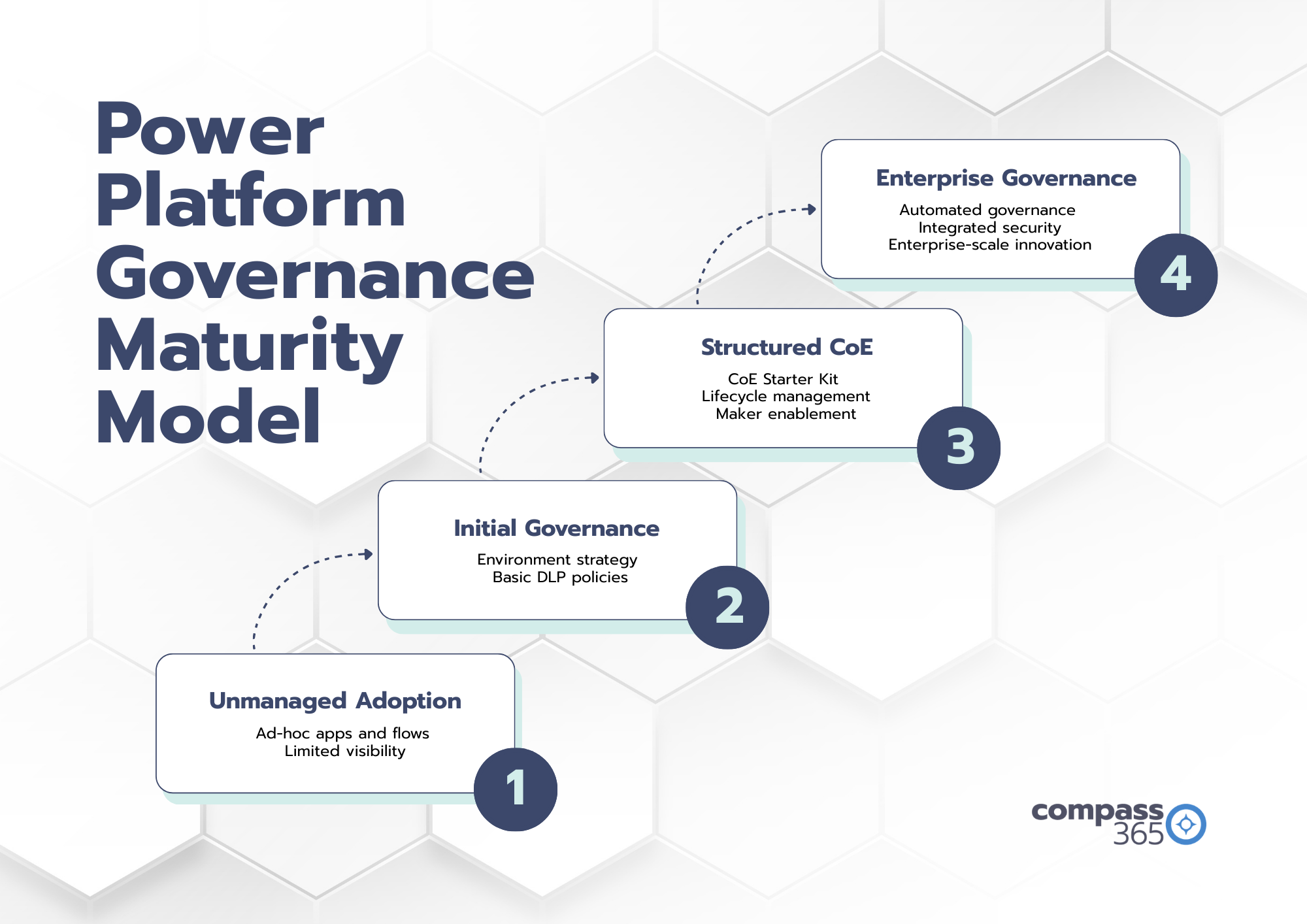
Power Platform governance maturity model illustrating the progression from unmanaged adoption to enterprise-scale governance supported by a Power Platform Center of Excellence.
Stage 1: Unmanaged Adoption
At the earliest stage, Power Platform adoption is largely organic. Individual departments create apps and automations to solve local business challenges.
While this stage often produces quick wins, it also introduces risks. Organizations typically have limited visibility into how Power Platform is being used, and governance policies may not yet be defined.
Common characteristics include:
- Apps and flows created without central oversight
- Limited environment strategy
- Minimal security or compliance controls
- Duplicate solutions across departments
This stage often creates the momentum that leads organizations to establish a formal governance framework.
Stage 2: Initial Governance
As adoption increases, organizations begin implementing basic governance policies.
IT teams typically introduce environment management, establish Data Loss Prevention policies, and begin tracking platform usage.
Key indicators of this stage include:
- Defined environments for development and production
- Basic DLP policies for connectors
- Initial inventory of apps and flows
- Growing awareness of citizen development
At this stage, many organizations begin exploring the creation of a Power Platform CoE.
Stage 3: Structured Center of Excellence
In this stage, organizations formally establish a Power Platform Center of Excellence to manage adoption and governance.
The CoE introduces standardized development practices, monitoring tools, and maker enablement programs.
Typical characteristics include:
- Deployment of the Power Platform CoE Starter Kit
- Cross-functional governance team
- Solution lifecycle management standards
- Maker training and enablement programs
- Centralized monitoring and reporting
Organizations at this stage begin seeing more consistent, scalable results from their Power Platform investments.
Stage 4: Enterprise-Scale Governance
At the most mature stage, Power Platform governance becomes fully integrated with enterprise IT and data governance strategies.The CoE operates as a strategic capability that supports innovation across the organization while maintaining strong security and compliance standards.
Organizations at this stage typically have:
- Advanced environment management and automation
- Integration with Microsoft Purview and security platforms
- Automated monitoring and governance controls
- Enterprise-wide citizen developer programs
- Executive-level visibility into platform value
This level of maturity allows organizations to scale low-code development confidently while maintaining control of their digital ecosystem.
Case Study: Establishing a Power Platform CoE for a Global Maker Community
A leading global media and entertainment company with more than 200,000 employees experienced rapid Power Platform adoption across the organization. More than 10,000 citizen developers had created over 30,000 apps, flows, and bots to support business processes across departments.
While this growth delivered significant business value, it also introduced governance challenges including limited visibility into existing solutions, concerns about data exposure, and inconsistent development practices. To address these challenges, the organization partnered with Compass365 to implement a scalable Power Platform governance framework and establish a Power Platform CoE.
The initiative included assessing the organization’s Power Platform environment, implementing and customizing the CoE Starter Kit, and aligning IT, security, and compliance teams.
The result was a governance model that improved visibility and security while still enabling the organization’s maker community to continue innovating.
Read the full case study here.
Build a Scalable Power Platform Governance Framework
Governance is not just a technical requirement. It is a critical component of long-term success with Power Platform. As organizations expand their use of Power Apps, Power Automate, and Power BI, establishing a structured Power Platform governance framework and Power Platform CoE helps ensure the platform remains secure, compliant, and sustainable.
If your organization is experiencing rapid Power Platform growth, now is the time to establish the right governance strategy. Contact the experts at Compass365 to explore governance options and learn how we help organizations design and implement scalable Power Platform governance frameworks and Center of Excellence programs.
Strengthen your Power Platform governance while empowering your teams to innovate with confidence.